
Sustainability July 28, 2026
Is Your Business Ready for California’s Textile Waste Law?
California’s landmark extended producer responsibility legislation passed a key deadline earlier this month. Experts urge promo companies to make preparations now before full implementation of the law in 2031.
Key Takeaways
• California’s textile extended producer responsibility law will likely affect larger promo firms that sell product in the state.
• Qualified companies selling apparel and textiles into California should register with Landbell USA or face potential fines of up to $50,000 per day.
• Industry experts urge companies to organize product data now and prepare for customer questions ahead of full implementation in 2031.
Between 2000 and 2018, textile waste in the United States increased by over 50%, according to a report by the U.S. Government Accountability Office.
Textiles is one of the largest streams of waste in the country that is still unregulated – there’s not currently infrastructure in place in the United States to reuse, repair and recycle textile products.
That’s what California’s Responsible Textile Recovery Act of 2024 aims to do. The extended producer responsibility legislation aims to hold apparel and textile companies accountable for end-of-life product management. Landbell USA, the producer responsibility organization selected by CalRecycle, is now creating a needs assessment to set the baseline for what is needed by 2031 to comply with the law. This comes after the deadline for producers to register with the PRO passed earlier this month.
What Does the Law Mean for Promo?
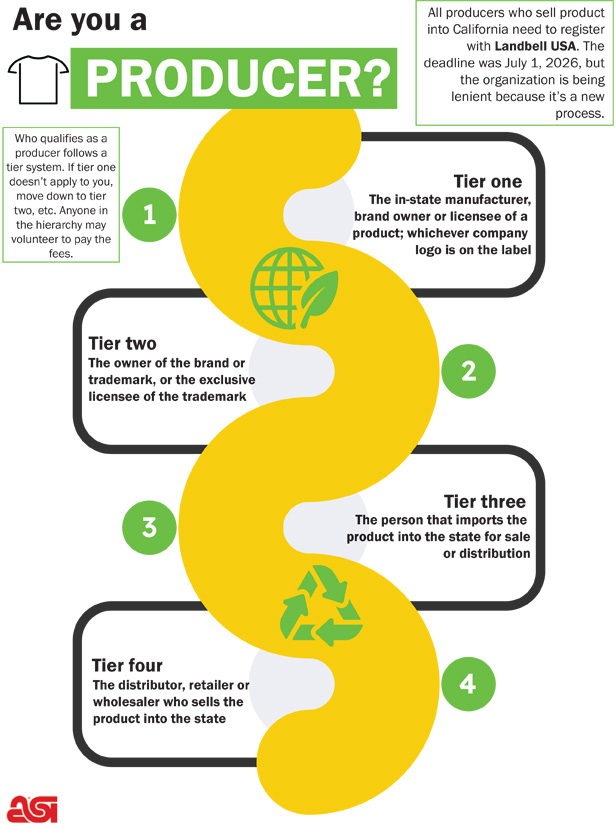
For promo pros, there’s been some confusion about who exactly needs to register with Landbell. California’s textile EPR bill defines a producer as the person who manufactures or owns the brand of a textile product that’s sold or distributed in California. In the promotional products industry, that means that both suppliers and distributors could be affected: If distributors are white-labeling products, they count as the producer; but if distributors are using supplier blanks, the responsibility would fall on the supplier, experts say.
“Legislation like this essentially raises the bar and makes it more expensive for people to make cheap products that fall apart. When everyone’s doing it, it levels the playing field a bit.” Andy Keller, ChicoBag (asi/44811)
Joanne Brasch, assistant director of the California Product Stewardship Council, says that potential producers should err on the side of caution and register, even if they’re not sure, adding that Landbell USA and CalRecycle have gone out of their way to be lenient because they know it’s complicated.
“People think the manufacturers have to pay. It doesn’t fall on the factories. It falls on the brand putting the order into the factory,” Brasch says. “No one gets a refund of your membership [if a company registers but it turns out they’re not responsible], but there’s a really good chance they won’t be on the hook for paying the per unit recycling fees once the program starts.”
Although the bill was passed in the California legislature, any company that makes over $1 million in annual aggregate global turnover and who sells products into the state is required to sign up.
The form on Landbell USA’s website takes about 5 to 10 minutes to complete and requires basic information about the company, not product supply or volume data. It’s a $1,000 fee to register, but it’s up to a $50,000 fine per day for those who don’t.
Who counts as a producer follows a tiered system in the bill: The first person responsible is the manufacturer, or whoever’s name is on the label of the product. If not, the responsibility to register falls onto the next tier, the person who imports the product, and so on and so forth. Brasch adds that anyone in the hierarchy is welcome to volunteer to pay the fees.
Most of the logistics of how the bill will be implemented are still up in the air, and a lot of questions will be answered by the needs assessment coming March 2027. That includes information about what types of infrastructure California would need to recycle textiles, and subsequently, how much the fees for producers will be, as well as if there’s a need for increased takeback or mail-back infrastructure.
“Start preparing now. Start organizing your data now because your customers are going to ask you for help.” Sara Osorio, PRINTING United Alliance
“A lot of people are just kind of holding out to see how it’s all going to go down after this needs assessment,” says Lindsey Cole, Promo for the Planet advisory board member and senior director of marketing and communications at Ethix Merch (asi/189731), the Counselor 2026 Sustainability Advocate of the Year. “How much waste is there? Nobody’s ever researched this kind of information before.”
One possibility is increased infrastructure for takeback programs, which some companies in California already do. For example, B-Corp certified ChicoBag (asi/44811) has a program allowing people to send any bags they don’t use anymore, which are then used to distribute food at food banks.
“Legislation like this essentially raises the bar and makes it more expensive for people to make cheap products that fall apart,” says Andy Keller, CEO of ChicoBag and a member of the Promo for the Planet advisory board. “When everyone’s doing it, it levels the playing field a bit.”
Definitions To Know
Extended producer responsibility: an environmental policy that shifts the burden of managing end-of-life products from municipalities to the producers. California’s Responsible Textile Recovery Act of 2024 is focused on apparel and textiles. Other EPR legislation covers areas that include packaging and paper, batteries and electronics.
Producer responsibility organization: a nonprofit organization formed to manage the end-of-life of products, usually formed to comply with EPR laws. In this case, Landbell USA is the PRO and was selected by CalRecycle.
Repair: any alteration or improvement of damaged product deemed worth the cost of repair. For example, redesigning or repurposing, mending rips or tears, dyeing or re-dyeing, or preparation for reuse and resale.
Reuse: the resale of a collected covered product to a consumer for its original intended use with or without repair.
Takeback program: A structured initiative that allows consumers to return used products or packaging for safe recycling, reuse or disposal. Designed to help businesses be responsible for a product’s entire life cycle.
Mail-back program: A method of collecting covered products using prepaid, pre-addressed mailing envelopes, boxes or other means that are reusable, recyclable or compostable.
Upcycle: The process of transforming old, discarded or waste materials into new products of higher quality or functional value.
Along similar lines, Brasch says upcycling is the area with the most potential for the law. Upcycling old products is one of the pathways to no fee requirements, and lawmakers intend to incentivize producers to create more environmentally conscious products.
“I know it’s not easy to say, like, ‘We’re all going to upcycle’ when it’s merch and promo stuff. But it is possible,” Brasch says. “You could upcycle shirts where no one wants that logo anymore into kid’s shirts.”
In fact, some distributors have already taken initiative to find new life for excess promo items. For instance, SwagCycle, a landfill diversion solution started by Counselor Power 50 member Ben Grossman, has facilitated more than $12.6 million in charitable giving and diverted more than 3.3 million branded items from landfills since launching in 2019.
Many of SwagCycle’s project involve apparel. “We’ve proven that obsolete swag doesn’t have to end up in landfills, that charitable impact can scale dramatically and that security concerns around branded merchandise require sophisticated solutions,” Grossman, co-president of Woburn, MA-based Grossman Marketing Group (asi/215205), said when he released SwagCycle’s most recent impact report.
Lessons Learned From European EPR Laws
Although this is the first textile EPR legislation in the United States, many European countries already have textile laws. When drafting the legislation, Brasch says European examples were used more so for what not to do.
For example, in France, there’s not a lot of reporting and tracking requirements after the product is initially sold. So, in the California bill, the definition of “reuse” says that the product must be used by an end-user for its original intended use.
“A lot of materials are getting dumped on secondhand markets because they’re like, we have to meet our reuse goal,” Brasch says. “No one’s actually seeing if those materials are getting reused.”
California Textile EPR Timeline
Here’s a timeline of significant milestones as California’s textile EPR legislation goes into effect:
Feb. 27, 2026: CalRecycle selected Landbell USA as PRO.
July 1, 2026: Deadline for producers to register with Landbell USA.
Aug. 13, 2026: CalRecycle will hold a public workshop to solicit feedback on regulation concepts outlined in the bill.
March 1, 2027: Landbell USA Needs Assessment due to CalRecycle.
July 1, 2028: Deadline for CalRecycle to adopt implementing regulations.
July 1, 2030: Landbell USA must submit an approved stewardship plan to CalRecycle.
2031: Landbell USA must fully implement the plan.
Another European connection: Landbell USA is part of Landbell Group, which was one of the world’s first textile PROs in the Netherlands.
As many in promo know, the textile supply chain is a little bit different for promo compared to retail. Although the production is similar, the distribution and the collection of the end-product are different, says Sara Osorio, manager for EHS and sustainability at PRINTING United Alliance, ASI’s strategic content partner.
Osorio says that some brands are starting to realize that a lot of the data they’ll need to report to the government is fragmented, so they’re having to spend time collecting it.
“Start preparing now. Start organizing your data now because your customers are going to ask you for help,” Osorio says. “Suppliers in general right now have a really good opportunity to stand out and be like that star supplier and gain new business by being EPR ready.”

Promo for the Planet is your destination for the latest news, biggest trends and best ideas to help build a more sustainable and socially-responsible industry.