
Sustainability March 25, 2026
The Promise (and Limitations) of Recycled Polyester
rPET has become popular in apparel and promo as a more sustainable alternative to virgin polyester. But behind the production process story lies a complex recycling system, quality variability and fraud risks that make supply chain transparency critical.
Key Takeaways
• Recycled polyester (rPET) demand is rising fast, but the environmental benefits depend heavily on how the material is sourced, processed and verified. Mechanical and chemical recycling methods each come with trade-offs in cost, energy use and potential environmental impact.
• Supply chain transparency remains a major challenge. Because recycled and virgin polyester are chemically identical – and recycled material often sells at a premium – mislabeling and fraud are difficult to detect without strong certification and traceability systems.
Every time someone tosses a plastic water bottle into a recycling bin, there’s a chance it will end up as a T-shirt, tote bag or a branded fleece jacket. That’s the promise of recycled polyester (also known as recycled polyethylene terephthalate or rPET), a material that has become one of the most popular fabrics in both fashion and the promotional products space. But the process comes with trade-offs, and in supply chains where greenwashing is ever-present, fraud is more common than many realize.
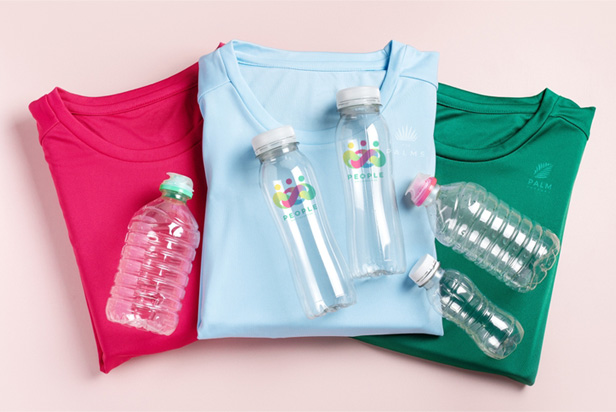
At its most basic, rPET is polyester made from recycled plastic, typically from water bottles. The bottles are collected, cleaned and processed into small flakes, which are melted down and turned into pellets, then spun into polyester yarn that can be woven into fabric. The process diverts plastic waste from landfills and typically requires less energy to produce than virgin polyester, which is derived from fossil fuels.
“Together, those factors help lower carbon emissions and the overall environmental footprint of the product,” says Saadia Bryant, vice president of marketing, product and design at Counselor Top 40 supplier Gemline (asi/56070).
How Is Recycled Polyester Made?
But in practice, the process is far more complex, involving several recycling methods, each with its own advantages and risks.
Sumit Sarker, an expert at Swiss-based sustainable textile certifier bluesign, breaks it down into two primary pathways: mechanical recycling and chemical recycling. Mechanical recycling is the market-dominant approach: Take clear, pure, clean textile scraps, shred them down to the finest possible particle, melt and respin them into fiber. It’s cost-effective and widely adopted, but it comes with a significant limitation of not being able to remove color.
“Every option involves trade-offs. There, unfortunately, isn’t a perfect material.” Saadia Bryant, Gemline (asi/56070)
That’s where chemical recycling enters the picture. Instead of physically grinding and melting material, chemical recycling breaks waste down to the molecular level, all the way to its basic building blocks. The advantage is the ability to remove impurities, dyes and contaminants, producing a recycled material that matches virgin-quality fiber. But the trade-off is steep. Chemical recycling is energy intensive and requires the addition of solvents and other chemicals that, if not handled responsibly, can create new environmental and worker safety risks.
“You want to get rid of something, but in the process, you’re adding something,” Sarker explains. “If those added chemicals aren’t safe and aren’t handled properly during the manufacturing process, then it creates an additional risk.” The solution, he says, is a rigorous screening of all chemical inputs from the start to the end of production to ensure they don’t include restricted substances, combined with proper handling protocols.
Despite its complexities, demand for rPET has surged and is still climbing. Globally, recycled polyester reached an estimated market size of $16.8 billion last year, according to Grand View Research. By 2030, the market research firm estimates it will reach $26.18 billion. Recycled polyester accounts for about 12% of all polyester manufactured, according to recent figures from Textile Exchange.
The Growth of Recycled Polyester in Promo
In promotional products, the growth has been just as pronounced. At Gemline, Bryant says the change in buyer behavior has been unmistakable. “Distributors and their end-clients are asking more questions about material sourcing, recycled content and environmental impact,” she says. “What used to be a ‘nice to have’ has increasingly become an expectation.”
12%
the percentage of the polyester market that uses recycled, rather than virgin materials.(Textile Exchange)
Koen Warmerdam, co-founder of AWARE, a blockchain-enabled textile traceability platform, sees the same pattern playing out across the Atlantic. “In Europe, the B2B players all use recycled polyester materials,” he says. “I see the same transition now happening in the U.S. It began maybe a little bit later, but when they started, they adopted faster and also at scale.”
However, critics have raised legitimate concerns. One of the most frequently cited is microfiber shedding: When synthetic fabrics are washed, they release tiny plastic particles that flow through wastewater treatment systems and ultimately into waterways. Research shows that recycled polyester sheds more microfibers than virgin polyester, potentially because the shorter polymer chains that result from the recycling process produce fibers that break apart more easily.
Because of this, Sarker urges people to use a holistic view when evaluating any recycled material. “Many people think that it’s almost the better option compared to the virgin feedstock,” he says. “But it’s not automatically safe in every perspective.”
He also points to resource efficiency as an example: If a recycling process consumes three times more water and energy than a conventional manufacturing process, the net environmental benefit may be negligible or even negative. “You have to ensure all those different aspects are taken into account, not just the final product, but a system-level approach from start to beginning,” he adds.
But one of the biggest questions is what happens at a product’s end of life. Polyester, recycled or virgin, doesn’t biodegrade. Some sustainability experts argue that the industry should be pivoting back toward natural fibers like cotton and wool precisely because they decompose.
Bryant acknowledges the tension, but pushes back on the idea that natural fibers are automatically the answer. “Every option involves trade-offs,” she says. “There, unfortunately, isn’t a perfect material.” She points to the water intensity and land use requirements of cotton cultivation as counterweights to its biodegradability advantage.
Sarker takes a more structural view of the natural vs. synthetic debate: “Compared to the consumption of our whole world, we can’t cover everything with natural fiber. The biggest challenge is the waste. Once this wears off, what do we do with it? If we don’t recycle, the mountains of waste will keep rising.”
His argument is that the future of sustainability in textiles isn’t about choosing between materials, but about closing the loop on whichever materials we use.
Is All Recycled Polyester Created Equally?
This brings the conversation back to if all rPET is created equally. The quality of recycled polyester can vary significantly depending on where the source material comes from, how it was sorted and cleaned, and what recycling process was used. At its best, rPET fabric is virtually indistinguishable from virgin polyester in terms of durability and performance. At its worst, inconsistent feedstock and poor processing can produce fiber that’s weaker or less consistent in texture.
For buyers, whether they’re distributors sourcing branded merchandise or brands building a sustainable product line, Bryant says transparency is the most important factor to evaluate. “Look for suppliers who can verify recycled content and who work with established certification systems, such as the Global Recycled Standard (GRS),” she says. “Those standards help ensure that the recycled content is legitimate and that the material has been processed responsibly.”
Perhaps the most sobering part of the rPET supply chain is the widespread fraud and mislabeling that consistently occurs. Because recycled polyester commands a price premium over virgin polyester, there’s a financial incentive to misrepresent materials at multiple points in production. And because recycled and virgin polyester are chemically identical – they’re both polyethylene terephthalate – it’s extremely difficult to detect substitution after the fact.
Traditional supply chain documentation doesn’t help much. Verification data is scattered across private databases held by certification bodies, exchanged over WhatsApp and WeChat, and reconstructed after the fact rather than recorded in real time.
“It’s horrible. It’s just not workable,” Warmerdam says.
According to the 2023 Textile Exchange Supply Chain Transparency Index, 78% of verified “recycled PET” claims lack third-party traceability beyond the final spinning mill.
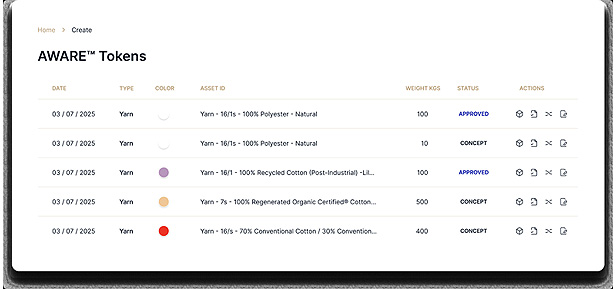
AWARE uses blockchain technology to provide supply chain traceability for rPET and other sustainable textiles.
Warmerdam says that AWARE was built to fix that. The platform creates a digital twin of physical materials – starting with the recycled pellet at the beginning of the rPET supply chain – and traces that material forward through every processing step using blockchain technology. Each kilogram of material in the system is represented by a token that carries all associated data: feedstock source declarations, supplier certifications, compliance test reports and delivery notes. When a brand like Gemline places an order, every stakeholder in the supply chain gains full access to the transparency data linked to that specific purchase order.
For end-consumers, every validated product contains a QR code that links to the full provenance data. And with the European Union now mandating a digital product passport for all imported goods starting in 2027, Warmerdam sees that what AWARE has built for transparency is now becoming a baseline regulatory requirement. “In the U.S., it isn’t mandatory yet,” he acknowledges, “but legislation is pushing toward traceability. I can imagine that more proof will be demanded on recycled polyester as well.”
The longer-term horizon points toward something more ambitious. Warmerdam is aware that the current bottle-to-fabric model has limits. “I think it’s great that in the future we step away from PET bottles, because now there are such cool developments regarding textile-to-textile recycling,” he says.
Next-generation recycling would take worn-out clothing and break it down into plastic pellets, allowing the material to be rebuilt into new polyester fibers. Because the source material is already textile – not plastic bottles – it could create a true “closed loop” system and reduce the need to make new plastic from fossil fuels.
“In the U.S., it isn’t mandatory yet, but legislation is pushing toward traceability. I can imagine that more proof will be demanded on recycled polyester as well.” Koen Warmerdam, AWARE
For distributors, the practical takeaways are straightforward: rPET is a sustainability upgrade over virgin polyester, but it’s not the be-all and end-all. Quality varies, and so does the integrity of recycled content claims. Certifications like GRS and bluesign add important layers of verification, but the most robust assurance comes from suppliers who can demonstrate transparency at every level of their supply chain.
As Bryant puts it, the goal isn’t to find a perfect material; it’s to make thoughtful choices, finding materials “that balance performance, durability and environmental impact for each and every product.”
In an industry still navigating what sustainability really means, that kind of honest accounting may be the most valuable thing of all.

Promo for the Planet is your destination for the latest news, biggest trends and best ideas to help build a more sustainable and socially-responsible industry.