
Strategy September 30, 2026
The ‘Lifestyle Brand’ Playbook: How Buzzy Companies Like OpenAI Are Using Promo
To build consumer loyalty and communities that extend beyond their core products, end-buyers are making merch a bigger — and earlier — part of their brand-building strategy.
Key Takeaways
• End-buyer companies are operating like lifestyle brands by using merch beyond their core product offerings.
• Promo can build identity and community before a devoted following exists.
• Retail-inspired products and custom designs create merch that consumers actively want to buy.
There’s no bigger buzzword right now than “AI.” It’s dominating seemingly every corner of society – including conversations about trendy merch.
Palantir launched a $249 denim chore coat. Anthropic had its “thinking cap.” OpenAI’s online company store, Supply Co., opened to the public in July; it features a now-sold-out ChatGPT-branded basketball and a T-shirt reading “Good Research Takes Time.” Each offering from these tech giants elicited mainstream media coverage for something other than company valuations or swirling fears that AI is ushering in the end of humankind.
High-profile tech merch is nothing new, but what’s different now is that AI companies are aiming their promo directly at consumers, instead of strictly inward toward employees. It’s a kind of brand building that allows companies to say who they are beyond their core products – a move straight from the playbook of well-established “lifestyle brands.”
Traditionally, lifestyle brands have built an identity and cultural ecosystem beyond their initial product offerings, giving consumers something to identify with rather than simply something to buy. Not every company is trying to become the next Nike, Harley-Davidson or Disney. Still, today’s buzziest brands – from high-powered AI firms to cult-favorite gas stations to social-first Gen Z-targeted brands – are seeking to build a broader world around themselves well before developing the kind of following that once made such a strategy possible.
“Merchandise used to be the last mile of somebody’s campaign,” says Michael Scott Cohen, co-founder of NYC-based distributor Harper + Scott (asi/220052), which was acquired by Counselor Top 40 distributor BDA (asi/137616) last year. “And now it’s ‘Can we launch with merch?’”
And not just any promo items. Creative custom products available through consumer-facing stores like OpenAI’s Supply Co. site are becoming essential tools for companies to build connections and spark conversations.
“Given the fact that this is an attention economy, eyeballs are everything,” says Carmela Wagner, vice president and global brand consultant at Counselor Top 40 distributor Nadel (asi/279600), who operates OpenAI’s Supply Co. store. “This is going to be a big part of their brand story, and if you think about it, it’s an artifact – not just a product.”
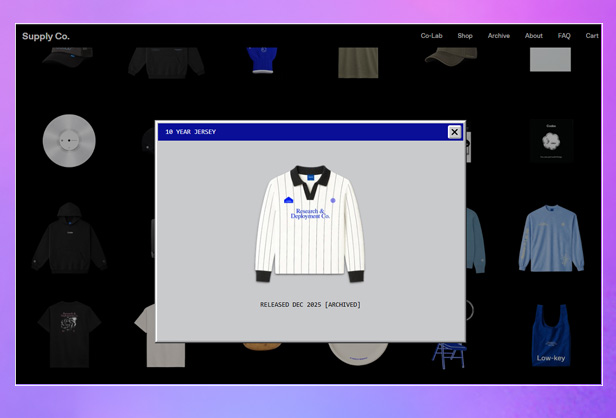
OpenAI’s Supply Co. storefront features an “archive” section with previous merch drops and out-of-stock products.
Promo as Storytelling
Promo serves a particularly distinct purpose for these AI powerhouses: It’s a tangible representation of an intangible product. As these firms race to differentiate themselves in an increasingly crowded marketplace, quickly telling the story of who they are as a brand has become crucial.
And merch – good merch – is one notable way they’re doing it. The Supply Co. website in fact showcases OpenAI’s history through an archive of OpenAI’s internal collections before the store went public.
For OpenAI, though, using merch to tell the company’s story also meant ensuring the products themselves reflect the ambitions of the company behind the store, Wagner says.
“Superintelligence cannot live side by side with junk,” she adds. “It has to be thoughtful. It has to be inspired. It has to be high quality.”
It’s not just the AI sector where this is happening. Consumers are exposed to an ever-increasing number of products across all verticals, especially through social media, making genuine connection harder to forge, but more valuable. For the brands that manage to break through the noise, there’s potential to create followings as dedicated as those of TV or movie fandoms.
“Superintelligence cannot live side by side with junk.”Carmela Wagner, Nadel (asi/279600)
For these companies, branded products are another tool for helping define their identities before they’re even fully formed in the public consciousness. Lia Coonley, a senior account executive at Blink Marketing (asi/141424), works with a wide variety of beverage startups whose marketing is as much about showing consumers what life with the product looks like as advertising what’s in the drink.
“A bulk of [their sales strategy] is selling the actual product,” Coonley says. “And then after that, you’re also selling the occasion around whatever your product is – and you can’t always just do that with whatever is in the bottle or the can.”
“The physical product – you need to consider it a communication vehicle like you would anything else,” adds Tommy Gomez, senior director of creative strategy at Brilliant (asi/146116). “It’s another tool to tell the story.”
A piece of that broader story is building something that consumers want to participate in – and ultimately, identify with. That potential is particularly valuable among Gen Z consumers, for whom feeling a part of something can drive significantly stronger brand interest and participation, says Chris Ribeiro, a marketing professor at Rutgers Business School with a background in consumer insights at top apparel and lifestyle brands.
Merch gives consumers a direct choice to make that affiliation visible, says Allison MacDougall, Counselor’s 2026 Up-and-Comer of the Year and a senior account manager at Whitestone (asi/359741). In the same way that spotting someone wearing concert merch from a favorite artist creates an instant connection, sporting an OpenAI baseball cap or a brightly colored hoodie from prebiotic soda brand poppi can signal a shared interest.
“It becomes almost like a brand trophy,” MacDougall says. “[It signals] you’re a part of this community.”
These companies don’t have decades of brand cache behind them. But they’re not waiting to build the broader ecosystem of products, experiences or other cultural touchpoints that they hope consumers will associate with them.
“[Promo] becomes almost like a brand trophy. [It signals] you’re a part of this community.”Allison MacDougall, Whitestone (asi/359741)
“It’s about how people shop. It’s about how people live,” says Derek Peoples, vice president of creative services at The MRL Group (asi/258137). “The more you meet them there, the better you’re going to connect with them.”
That means more companies can reach for those strategies (including merch) before they’ve built the following traditionally associated with them.
“It used to be that brands had to reach a certain level before they turned ‘on’ that lifestyle,” says Shannon Ramdhan, a marketing consultant at The MRL Group. “Whereas, now, I feel like they’re creating the demand for it before it’s naturally happening.”
Starting With Merch
As more companies adopt this “lifestyle” approach, merch conversations are happening earlier in the brand life cycle. Coonley’s clients, for one, can’t wait to discuss their promo strategy. “Once they get the product down, they’re going straight to the merch,” she says. “And some of them haven’t even gone to market yet.”
“Once companies get the product down, they’re going straight to the merch – and some of them haven’t even gone to market yet.”Lia Coonley, Blink Marketing (asi/141424)
That’s been especially visible among the wave of social-first food and beverage brands that have emerged in recent years. Coonley recently worked on a set of bachelorette kits for ready-to-drink brand Mom Water – only to run into one of those kits in the wild while attending a bachelorette party herself.
With merch being asked to do more – both communicate a brand’s identity and earn a place in consumers’ everyday lives – there’s an inherent expectation that the product can stand alongside retail, says Trevor Hyssong, Blink Marketing’s director of sales.
“Who cares if I’m buying it from Everlane?” asks Wagner, referring to the popular apparel retailer. “Why can’t I buy it from a tech brand?”
Hoodies, graphic cotton tees and baseball caps remain popular promo staples that aren’t going anywhere. But advances in operations, production technology and decoration have made fully custom products with lower minimums easier than ever.
More flexible brand guidelines are also making a retail-oriented approach attainable, Gomez says – something more akin to launching an original apparel line than a traditional company store. Accordingly, demand for private-label, fully custom or semi-custom products has surged as brands seek to build something exclusively theirs.
“It’s almost moving past fifty-fifty, at least in my portfolio, of people that want something completely from scratch,” Coonley adds. “You see so much branded stuff now that a logo by itself on something isn’t enough. You have to take it a little bit further.”
And brands are borrowing more from retail than merely product inspiration. Limited-edition releases or exclusive collaborations, MacDougall says, can create urgency around a launch that makes consumers feel like they need to participate, or they’ll be missing out.
55%
The percentage of consumers who said quality would influence their willingness to purchase a promo item(2026 ASI Ad Impressions Study)
The perfect store, though, isn’t any good if people forget about it after a week. Gomez says that seasonal drops or collaborations, ideally tied to something happening within the company, help keep things fresh and relevant.
For Delta’s 100th anniversary, for example, Harper + Scott worked with Nike to create custom Air Force 1s for employees. They expected to sell maybe 500 pairs, but the final order count reached more than 17,000.
“You have to find ways to get people to come back,” says Cohen, a member of Counselor's Power 50 list of the most influential people in promo. “Yes, they might buy the standard T-shirt with the Delta logo on it, but they wouldn’t have seen it if they didn’t have these collaborations pop up every now and then and remind them that there’s a store that exists for them to come to.”
Know the ‘Why’
Perhaps most importantly, this strategy has the potential to change where merch fits into companies’ overall marketing mix. Many brands are shifting their advertising dollars away from paid digital ads and toward engaging with creators and the community, Ribeiro says. Physical merch offers a way to take that connection offline.
“They’re funneling that money into things that can help them manufacture a sense of authenticity and belonging,” Ribeiro says. “There have been a lot of dollars shifting into what is technically still paid media, but it’s more organic.”
Even though any company can take a lifestyle-oriented approach to their brand, it doesn’t necessarily mean they should. When a potential client tells Cohen, “We want a merch store,” his first question isn’t about budgets or expected order quantities. It’s “Why?”
Wanting a merch store because everyone else has one isn’t good enough, he says. Without a genuine story behind it, even a well-executed collection can fall flat.
“Merchandise used to be the last mile of somebody’s campaign. Now, it’s ‘Can we launch with merch?’”Michael Scott Cohen, Harper + Scott, a BDA company (asi/220052)
“You have to figure out what authentic means to your brand,” Ribeiro says. “People will know that you’re being fake right away, and they’ll call you out on it, and they’ll reject you for trying to do that.”
An effective “why” will look different for every company – Cohen points to a quick-service restaurant that wanted to use merch to re-engage younger consumers after feeling like the brand had lost its “cool” factor.
But the goal shouldn’t be simply to put another logo in someone’s closet.
“It’s not ‘I want to put my logo in front of you,’” Coonley says. “It’s ‘I want you to want this, and I want you to keep it.’”
For distributors, getting that equation right could lead to bigger, more impactful client conversations – and unlock budgets traditionally reserved for “out-of-home” advertising, Gomez says, when they can demonstrate the value of merch as a tool for building both connections and brands.
Again, though, it’s the combination of a compelling story and equally compelling product that’s the differentiator. When consumers choose to keep, share and wear a product, it’s a signal that a brand has done something right.
“All merch is not media – there’s a lot of merch that’s waste,” Cohen says. “Merch that is media earns the attention it deserves.”