
News October 20, 2026
Distributors Weather Challenges To Increase Sales 3.4% in Q3
Confidence ticked up and larger distributors thrived in the face of tariffs and cost pressures.
Key Takeaways
• North American distributor sales rose 3.4% year over year in Q3.
• Distributors with over $5 million in annual revenue had the strongest quarter with 6.4% growth.
• Tariffs, inflation and the Iran war remain key concerns.
• Industry confidence increased to its highest level since the end of 2025.
Despite a weakening labor market, rising inflation and sky-high oil prices, consumers are still spending.
It’s a behavioral pattern known as “the lipstick effect,” which suggests that consumers prioritize small luxury items during times of economic uncertainty.
It shouldn’t come as a surprise, then, that the promotional products industry – one that, in many ways, is in the business of selling small (and some large) luxuries – is once again proving resilient.
The latest ASI Quarterly Sales Survey from ASI Research shows that North American distributor sales rose 3.4% in the third quarter compared to the same period last year, marking the industry’s fifth consecutive quarter of growth.
However, those gains were uneven. Large distributors (over $1 million to $5 million in annual revenue) and extra-large distributors (over $5 million) posted sales increases of 3.4% and 6.4%, respectively. Sales were flat for midsize distributors (over $250,000 to $1 million), while the smallest distributors ($250,000 or less) saw sales decline 1.8%.
The data comes as the Bureau of Labor Statistics released its Consumer Price Index report, which shows prices in the U.S. rose more than half a percent in September – the largest monthly increase in five months and 3.7% higher than the same time last year. As suppliers continue to pass along rising costs to ease their pricing pressures, some of the industry’s quarterly sales growth may reflect higher prices (end-buyers paying more for the same amount of goods) rather than increased order volume.
It’s not just the U.S. that’s feeling the impact of higher prices. Last week, the International Monetary Fund released its world economic outlook, which warned that the global economy could “soon test the limits of resilience.”
“The promo market in Q3 remained very much in a ‘wait and see’ mode,” says Nate Kucsma, ASI’s senior executive director of research. “While overall sales are up, there are still several areas weighing on the overall market such as the Iran war, tariffs and their effect on the U.S. economy. Q4 is often a make-or-break quarter for the industry – maybe more so this year.”
However, through all these external factors, promo distributors are chugging along.
3.4%
Estimated year-over-year sales growth for the promotional products industry in Q3 2026(ASI Research)
Sales momentum and cautious optimism on the part of distributors are reflected in the Counselor Confidence Index, which measures promo industry health. The metric reached 91 this quarter compared to 87 and 88 in the first and second quarters, respectively. (The industry last reached the Counselor Confidence Index’s baseline of 100 at the end of 2024.)
According to the survey, 36% of distributors reported sales were better than they expected, while 26% said the quarter fell short of expectations.
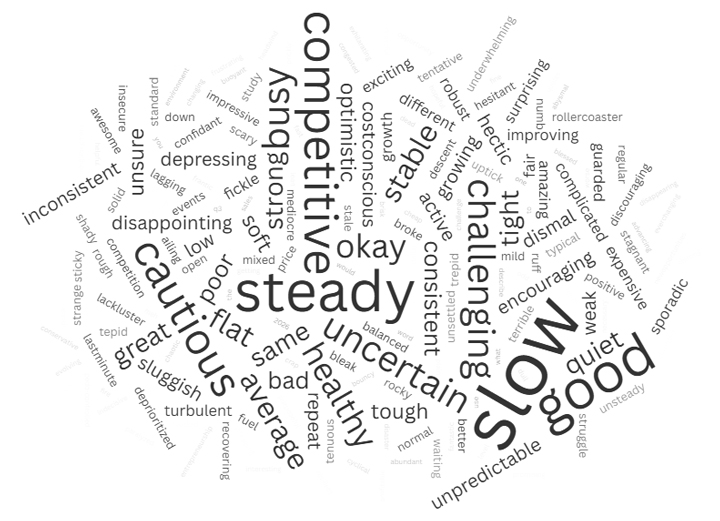
Still, hurdles remain. When asked to describe their quarter in one word, many survey respondents used words like “slow,” “challenging” and “uncertain.” Other responses included terms such as “good,” “steady” and “competitive.”
We asked distributors: Which one word would you use to describe Q3?
Tariff Uncertainty Continues, but Businesses Are Adjusting
Tariff news showed no signs of slowing this quarter, but industry reactions to the levies have eased over the last several months.
“Tariffs are kind of old news,” says Chris Faris, founder and CEO of Boost Promotions (asi/142942). “Our clients know that, right now, there’s no other alternative. Like, if you want this completely custom piece, we have to go to China or another country.”
Still, this quarter produced some big updates on the tariff front. In July, the White House introduced new baseline tariffs ranging from 10% to 12.5% on 60 of the U.S.’s trading partners, ostensibly replacing the global tariffs the U.S. Supreme Court struck down in February. The U.S. and China also agreed recently on a bilateral tariff reduction that would apply to $60 billion in goods traded between the two countries, though few popular promo product categories were impacted.
There were also the 50% tariffs that President Trump imposed on $20 billion worth of goods from Canada at the end of the summer after the two neighboring countries failed to reach a trade agreement. (Canada took retaliatory measures of its own, with Prime Minister Mark Carney instituting levies on more than 700 American-made products.) Those levies come just months after the U.S. announced it wouldn’t renew the United States-Mexico-Canada Agreement, kicking off a series of annual reviews the three countries will conduct until USMCA expires in 2036.
Craig Nadel, the president/CEO of Counselor Top 40 distributor Nadel (asi/279600), added that the tariffs have certainly been a bump in the road. But as someone who has been working in the industry for several decades, he’s witnessed much more impactful economic events.
“The 2008 financial crisis … now that was awful,” says Nadel, who is also a member of Counselor’s Power 50 list of most influential people in promo. “Recessions happen from time to time, but I don’t think there will be one that bad. At least I hope there isn’t, because that was terrible.”
Still, many suppliers and distributors have told Counselor that the ever-changing nature of tariffs has made it hard to make long-term business plans. According to ASI’s survey, 83% of respondents said they were at least a little bit concerned about increased tariffs over the next year, while 77% expressed at least slight worry about trade relations between the U.S. and Canada.
Tariffs were costly in 2025 and continue to be so this year. ASI Research shows that, last year, suppliers with over $25 million in revenue paid over $3 million in tariffs. Smaller distributors paid much less on average (nearly $45,000), but that still constituted at minimum 4% of their annual revenue.
Some distributors are finding ancillary benefits. The Canadian tariffs, for example, are prompting buyers to move quicker. Hampstead, Quebec-based Solutions Ink (asi/329824) experienced sales growth, and Company President Steven Schneidman hypothesized that some clients may have wanted to get their orders in before potential tariff increases went into effect. “People are trying to get ahead of the game,” says Schneidman, who buys a number of goods from American suppliers.
Last spring, the government launched the Consolidated Administration and Processing of Entries, an online portal where eligible companies could request a refund for duties they paid on Trump’s now-defunct IEEPA tariffs that were struck down by the Supreme Court. Still, unless they’re importing goods directly, many distributors aren’t eligible to receive a tariff refund. In fact, 54% of distributors who responded to ASI’s Quarterly Sales Survey said they weren’t eligible. ASI Research also found that 16% of distributors planned to request a refund, while 3% had already submitted a request.
MadeToOrder (asi/259540) Chief Revenue Officer Brittany Frase says she’s tracking the situation closely, but notes that “suppliers have more of an opportunity as the shippers, and as those that have inventoried product, to be able to capitalize on the refunds.”
Still, 27% of distributors who responded to the survey said they’re eligible for a refund but chose not to request one. One of these respondents is Christina Maag, CEO and brand consultant at Boise, ID-based distributorship Hoopla (asi/266578), who opted not to apply to get her money back because it presented an “operational burden.”
“We already have so many things we need to do,” says Maag, who deals directly with several overseas factories to import goods into the country. “To get to the bottom of how to submit the refund and what paperwork we would need, that would be difficult from an administrative perspective.”
Maag adds that she wishes there was a promo industry-specific service that would apply for refunds on behalf of companies, and claim a percentage of the tariff refund once approved.
Freight Delays & Longer Turnaround Times
The Iran war, which began last February, has also come with a price tag for businesses and consumers alike. According to recent estimates from Moody’s Analytics Chief Economist Mark Zandi, the Iran war has cost American households $2,000 each.
For promo businesses, perhaps the conflict’s biggest impact has been higher crude oil prices, which raise transportation costs and the cost of petroleum-based materials such as plastics and synthetic fabrics. Natural gas, too, has spiked in price, contributing to electricity and industrial costs for manufacturers.
Faris notes that some promo companies are feeling the financial hit more than others, depending on the products they offer and who they sell to.
“B2C companies are impacted more because they sell directly to consumers,” he says, referring to the fact that when costs rise, consumers tend to be especially sensitive.
He adds that products that require more energy to produce might be more heavily impacted than those that don’t require as much to manufacture.
In general, though, promo distributors are worried about oil prices and other financial impacts of the war. Nine out of 10 survey respondents expressed concern about how the conflict could impact business over the next 12 months, with nearly half of respondents (45%) saying they were “extremely concerned.”
“Our clients don’t know what’s coming next from a compliance standpoint, and they’re very aware that they need to get things into motion earlier.” Brittany Frase, MadeToOrder (asi/259540)
However, beyond the oil shock and rising inflation, the war in Iran has had ripple effects on the promo industry. Closures and threats around the Strait of Hormuz – a key choke point for oil and cargo shipments – have required many ships to reassess their paths, resulting in transit delays for many. That has led to longer lead times for distributors like Marcia Davis, who co-owns print and promo firm M and M Designs (asi/257885).
“I have to be very mindful of really long lead times for things that are made offshore,” she says. “I’ve gotten up against some really tight timeframes because things take longer, and shipping takes longer because of what’s happening in the Middle East.”
Compliance requirements for products being shipped in and out of the U.S. are becoming more stringent, adds MTO’s Frase. “It’s ever changing,” she says. “Our clients don’t know what’s coming next from a compliance standpoint, and they’re very aware that they need to get things into motion earlier.”
Being Proactive During Challenging Times
When economic conditions pose challenges, distributors must be proactive and resourceful. Davis, for instance, uses her background in project management and meeting planning to make sure clients start thinking about their campaigns ahead of time.
“I’m a planner,” she says. “I try to use my project management skills to manage customer expectations and timelines. That takes the pressure off me and my clients. Let’s not lose sleep when we don’t have to.”
Schneidman of Solutions Ink, whose quarter was up somewhere between 20%-25%, attributes his company’s sales growth to proactively providing spec samples to customers. “That usually pays off into orders more than just waiting for someone to call with a specific item that they’re looking for,” he explains.
Justin Zavadil, the CEO and president of Counselor Top 40 distributor ASB (asi/120075), says that his team is constantly monitoring the current economic situation. ASB’s first quarter runs from July through the end of September (the same period as most of the industry’s Q3). The Glenwood, MN-headquartered distributor splits its business pretty evenly between print and promo, and saw quarterly sales growth of about 15% across the board compared to the same time last year.
“We’re so spread across industries that we don’t have one busy time of year. You’ll always have different cycles, and we have different markets that are busy in different times,” says Zavadil, who is also a member of Counselor’s Power 50 list and the 2025 Person of the Year.
Nadel added that when a distributor’s business is diversified, it’s natural to see spending ebb and flow. “The economy does seem to be slowing down in certain sectors, and of course, we’re going to be impacted by that,” he says, although Q3 business is up overall for his company. He points to mortgage rates as a prime example of this cyclical pattern. In 2021, the average rate for a 30-year fixed mortgage hit a record low of 3%. Today, they hover at over 7% and increased nearly a percentage point since the early summer.
“A couple of years ago, we were getting a lot of business from mortgage companies, which was a great business a while back because rates were low,” he explains. “It was very attractive if you had a mortgage at 5% and rates were now 3.5%; you can actually pull money out of your home and keep your mortgage the same. That business is much less attractive when you’re going from 3% to 7%.” That slowdown is reflected in the survey findings for robust markets, with 8% of distributors naming real estate a robust market compared to 11% in the previous quarter.
Distributors named education, healthcare, construction and finance as their most robust markets in the quarter, matching previous findings.
Over a third (37%) of distributors reported growing sales this past quarter – the fewest since the second quarter of 2025. Faris, for his part, reports that Boost’s Q3 figures are relatively flat this quarter, just like about 30% of distributors.
Faris says his clients are less focused on price and more interested in value. “For us, it’s all about, ‘how can we help you within your department really act as a service with our infrastructure, our technology and our people?’” he explains. “We want clients to know that we’re going to make sure to take the work off their plates.”
This value-driven approach represents a growing trend where buyers are asking more from distributors than they ever have.
Dean Manzetti, vice president of Canton, OH-based print and promo distributor Canton Data Print (asi/156715), says nowadays, distributors must do a little bit of everything to stay competitive.
“You have to be full-service,” says Manzetti, whose company’s services include direct mail, print, publications, newsletters, promo and apparel. “You’re basically an extension of your client’s marketing team, or sometimes you’re their entire marketing team if they don’t have one.”
Many of Manzetti’s buyers are doing three jobs at once, he says. “It’s our job to take some of that work off their plate and make their jobs easier,” he adds. That also allows busy clients to work with a single company for all their marketing needs, instead of having to manage several lines of communication between different contractors.
But this trend of customers asking more from distributors highlights a growing sales disparity between the largest distributors and the smallest ones, says Nadel. “Whether it’s legal, freight expertise, compliance, clients now want a lot of things,” he notes. “That wasn’t necessarily the case 20 years ago.” With the increasing frequency of M&A activity across the industry, it’s the larger companies that can afford to offer all these services, says Nadel, whose company acquired Napa-based distributor Tugboat and Australian company All Branded Group earlier in the quarter. “Bigger companies are taking market share at the expense of some smaller companies,” he says.
Human Relationships Remain Critical
New technology has always significantly influenced how promo companies operate, with innovations like print on demand offering faster and often more economical techniques for decorators and distributors. In fact, among distributors who offer POD, 43% have grown sales for that service in 2026.
But perhaps the biggest technological impact this quarter for the print and promo industry – and the markets it serves – is AI.
Frase has witnessed more clients creating AI-generated or -modified artwork, which means, “some of their expectations, unfortunately, have become unreasonable with what decoration techniques can actually do,” she says.
The CRO adds that MTO’s clients aren’t necessarily asking the team to use AI, but rather, they’re asking for more mock-ups at once. “It’s easier than ever to pop one thing into AI, and for it to spit out 10 more designs or modifications,” she explains. “So, we’re being asked not just for one mock-up, but multiple because the expectation is that we are already using AI to increase productivity.”
Others, like Maag of Hoopla, use AI as a practical problem-solving and planning tool, mostly for operational purposes. For instance, she might plug an error message from a finance platform like QuickBooks into AI, and ask it to provide her with additional background. Or, when planning an event, she might ask AI to make her a logistics checklist to help her stay organized.
Learn more about how other distributors are using AI.
However, Maag says the rise in AI hasn’t necessarily translated into changes in her client base. Over the last few years, several AI startups have come up offering new tools, but Maag says many of them operate with lean marketing budgets. However, she has witnessed a healthy appetite from companies that manufacture memory for AI systems and other technology businesses.
Frase added that while the technology industry has certainly suffered in the last quarter – she points to layoff after layoff at big tech and software companies – MTO’s tech business has remained steady. Client contacts that have been let go from one firm have engaged with MTO from their new companies, which Frase says has actually helped diversify the distributor’s client base.
Despite the rise of AI, or perhaps because of it, human relationships are proving more important than ever.
“It’s very challenging to build relationships with people online,” says Davis of M and M Designs, who still gets most of her business through face-to-face networking.
Those relationships, however, continue to make a difference. “Our relationships are more relevant than ever,” says Frase, “and that’s what’s helping carry us through.”