
Strategy March 09, 2026
‘Marketing Is Easy. Entertainment Is Hard’: Lessons in Branding From Liquid Death Founder Mike Cessario
Cessario delivered a keynote presentation at ThreadX 2026 that focused on creating memorable and shareable marketing campaigns.
Key Takeaways
• Liquid Death founder Mike Cessario argued at ThreadX 2026 that successful marketing is fundamentally about entertainment, because memorable, shareable campaigns make brands stick in consumers’ minds.
• Authenticity and a distinctive brand identity are a company’s strongest competitive advantages, since larger competitors can easily replicate product features but not genuine brand culture.
• For smaller brands especially, marketing should prioritize creative, shareable ideas that spread organically on social media rather than polished but forgettable traditional advertising.
The task is to entertain.
Marketing is entertainment, and that includes your messaging, your printing, your packaging, your promotional products – all of it. If your product isn’t entertaining, it’s not sticking with the audience.
Liquid Death has personified this ethos of marketing through entertainment since its inception. It’s been very clear from the get-go: It’s just water. There’s nothing particularly special about the water itself, other than that it comes in a can. They didn’t invent water. But what Liquid Death might have perfected, or at least progressed, is the art of marketing itself using entertainment and memorable campaigns, positioning itself as one of the tastemakers in a product category famous for not tasting like anything.
Your branding is your identity and what makes your product or service unique and therefore worthy of the customer’s money and attention.
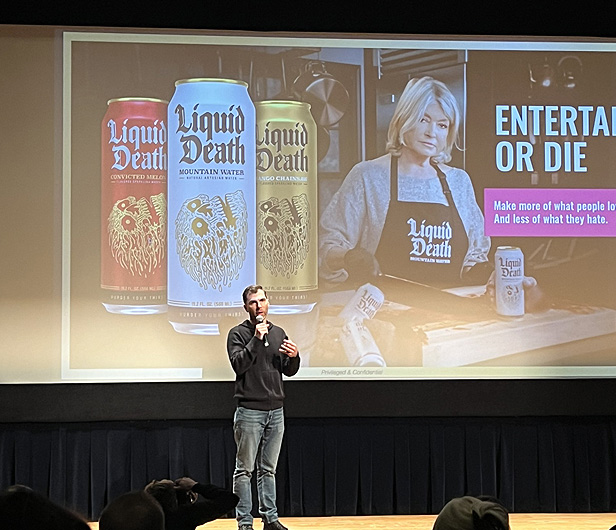
Liquid Death founder Mike Cessario spoke at the 2026 ThreadX conference about how to stand out with entertaining marketing no matter what your product might be.
“If you think about it in beverage, sure, you can have some new ingredient that no one else has,” Mike Cessario, founder of Liquid Death, said at the ThreadX conference last week in Sundance, UT. “But, as soon as your thing starts showing some growth, Coke, Pepsi or anyone else will replicate the exact thing for cheaper, put it in more places, and you’ll lose. The one thing they can’t replicate easily is brand and authenticity. Even if you’ve got hundreds of millions of dollars – and they’ve tried this many times – manufacturing authenticity with money just doesn’t work.”
Liquid Death is a unique case study in branding. Since its inception, the branding was always at the forefront alongside, or sometimes overshadowing, the “main” product, which was water and eventually other soft drinks like tea and flavored seltzer. The company did this with humorous commercials and unique promotional campaigns, like skateboards screen printed with skating legend Tony Hawk’s actual blood, an enema kit branded in conjunction with Blink-182 drummer Travis Barker and a lot more.
Standing out in the beverage market is how Liquid Death has managed to grow as quickly as it has despite not really offering anything that the competitors with much more money and clout could offer.
“We’ve gone into these categories where there aren’t many interesting brands,” Cessario said. “By being this sore-thumb brand, we can take market share without spending what everybody else spends. That’s how we can do it as a small company.”
That lesson translates over to promo, where a distributor might be tasked with creating a campaign for a small company that just doesn’t have the financial strength of some of their competitors. Cessario’s lesson drove the point home that money can buy a lot of things, but it can’t buy creativity or authenticity. If it could, every rich person would be a writer on SNL or have their own talk show.
“At the core of marketing, brand is really this: Why should anyone care about your company beyond the functional differences between your product and a competitor’s?” Cessario said. “It’s easy to make a cool product. It’s really hard to make a cool company.”
Never leave the safety of the mosh pit for a mid-show bathroom break ever again with the Pit Diaper from #LiquidDeath and powered by @Depend! The Pit Diaper is already SOLD OUT but you can still watch the commercial here: https://t.co/803tKCLfxQ pic.twitter.com/uudDNPGRtU
— Liquid Death (@LiquidDeath) December 5, 2024
So, what makes a brand or campaign cool? That’s harder to quantify. It’s more that people and consumers – end-recipients in the case of promotional products – can sniff inauthenticity. Younger generations especially can detect desperation to be seen as cool or cultivate some aesthetic that isn’t legitimately your own.
“People don’t think your company is cool because it uses taurine or some other ingredient,” Cessario said. “It’s what you do. It’s how you put your company out into the world that makes people want your company, not just your product. That’s how we think about Liquid Death. We’re an entertainment company that monetizes through beverage.”
Social Media Integration
Liquid Death benefitted from their commercials and content spreading on social media. He and his team recognized that this was just the way things were done now. It wasn’t advertising on TV. It was creating something provocative that would be shared by gazillions of people using social media platforms every day.
“There’s basically a Super Bowl every day on social media in terms of eyeballs,” he said.
For a promotional products distributor or print campaign designer, this is worth considering. How can your campaign live online in addition to the real world? Creating some sort of connection between social media and the product will create more interaction and enhance the reach of a campaign. If the packaging or design of the product alone is clever enough, it encourages people to share it around their own social media networks.
The trick is making your marketing effort feel like something fun, not a commercial. It’s the “spoonful of sugar” for the medicine (the brand).
“If you can actually entertain people while also delivering a message, that’s the key to unlocking this digital world,” Cessario said.
He likened it to the dawn of soap operas, where Procter & Gamble used dramatic television to market their products.
“That’s how you got into people’s minds: by entertaining them first and then tagging your brand to it in a subtle way, so maybe they’d remember your brand a week later when they were in the soap aisle,” Cessario says.
The takeaway, Cessario says, is not to just try to copy what Liquid Death did in terms of making funny, irreverent copy to disrupt the beverage industry. That’s just what came naturally to him as someone with a background in writing funny copy and a bit of a punk rock past. If that’s not who you are, it won’t be authentic. And creating a campaign for a customer using a certain vibe that does not suit them doesn’t help anyone.
“If you’re running a company, it’s much easier to lean into what you naturally understand and know how to do than try to force a totally different kind of brand,” he said.
Introducing a life-sized casket for death-sized beverages: The Casket Cooler from @liquiddeath x @YETICoolers. Featuring Triple Foam ColdCell™ technology, once you fill this one-of-a-kind giant casket with ice and Liquid Death, it will become the life of any party.
— Liquid Death (@LiquidDeath) August 28, 2024
We only made… pic.twitter.com/jOMhbVlVNZ
This is especially true if you are just doing what might have “always been done” or sticking with norms for the sake of conforming with the way things “ought to be done.” When you do things that way, you’re playing a game against competitors who might have a lot more brand recognition and money. Find what makes a brand and its story unique, and pursue that.
“I would argue that, especially as a small brand, it’s more reckless to market like the big companies do,” Cessario said.
He offered the example of “glamor shots” in food and beverage commercials.
“If a small company looks at that and says, ‘We have a little marketing budget – let’s spend $1,500 on a beautiful product photographer so our cans look really polished like the big brands,’ that money is gone. It will not move the needle. That, to me, is reckless. When you’re small, your only real shot is getting a huge number of people to know your brand quickly with a tiny budget. That means your marketing has to be shareable. It has to be interesting. It has to feel like news. It has to make people say, ‘Oh my God, did you see what this company just did?’ That’s how people spread your brand for you without you having to pay for every eyeball.”
Treat Your Marketing Like Art
The marketing pieces for a product, whether it’s print or promo or apparel, need to tell the brand story as well or even better than the product itself. It’s what connects the customer with their audience and captures their interest.
For distributors, marketing is the product, so this part isn’t a huge stretch.
“When you start thinking about marketing like a product, you ask different questions,” Cessario said. “Would someone actually tell somebody else about this? Would someone share this? What’s the last thing I personally shared? Would I care about this if it weren’t my brand? Those are hard questions. I’m not saying they’re easy to answer. It’s incredibly difficult – just like it’s difficult to come up with a hit TV show or write a great movie script. But if you at least hold yourself to that bar, you’ll end up in a much better place than if you just think, ‘Marketing is marketing.’”