
Strategy June 26, 2026
PPAI WLC 2026 Shares Insights on Career Growth, AI Adoption
Nearly 200 women attended the conference held in Milwaukee, WI.
Key Takeaways
• PPAI’s Women’s Leadership Conference brought nearly 200 attendees together for leadership development, networking and community service.
• Speakers encouraged women to lead with confidence and use AI as a thinking partner – not a replacement – by staying curious, questioning outputs and maintaining critical thinking.
PPAI welcomed nearly 200 women – about half of whom were first-time attendees – to its annual Women’s Leadership Conference (WLC) from June 22 to 24 at Saint Kate – The Arts Hotel in Milwaukee, WI.
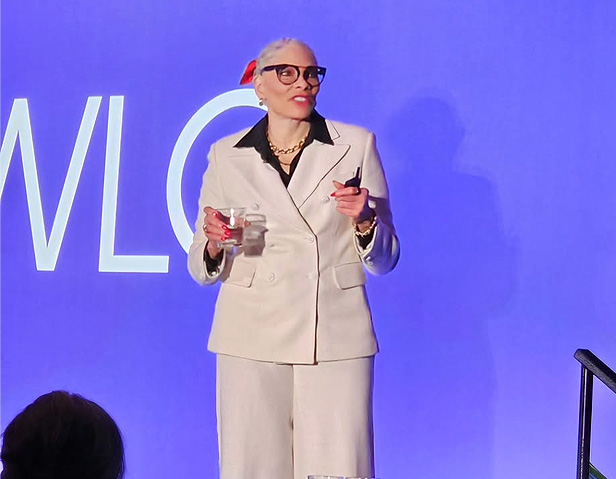
Ginny Clarke, a former executive recruiter at Spencer Stuart and Google, was one of the keynote speakers at PPAI’s Women’s Leadership Conference in Milwaukee, WI.
The event featured a full slate of keynote speakers and educational panels, as well as plenty of networking opportunities. In addition, attendees assembled feminine hygiene kits to support the Milwaukee Diaper Mission. Activations sponsored by Single Serve Merch and Counselor Top 40 supplier HPG (asi/61966) gave attendees the chance to build their own scented candle and customize a tote bag with various patches.
Ginny Clarke, a former executive recruiter at Spencer Stuart and Google, encouraged attendees to take control of their own professional and personal narratives. “I want you to stop playing small,” she said. “Show up; say something.”
To “Lead From Where You Are” – the title of the opening keynote – Clarke explained that women must know their competencies, but also listen to their intuition. “True leaders influence; they have vision and – my favorite word in our language – integrity,” she said. “That, to me, is the big one.”
Clarke outlined what she calls the five dimensions of conscious leadership: Know yourself, speak your truth, inspire love, expand consciousness and activate mastery.
Push beyond fear, imposter syndrome and self-doubt to embrace your potential. “When you master shutting down any of that negative self-talk, you become unstoppable,” Clarke said.
In the Wednesday keynote, neuroscientist Sarah Baldeo talked about how to embrace generative AI tools in a way that enhances human intelligence, rather than replacing it.
A few years ago, Baldeo and her team conducted a study asking nearly 2,000 people to solve a series of tasks using a commercially available AI tool to test different areas of executive function. Tasks included making a grocery list, solving a simple math problem, and reading and analyzing a long-form paragraph. Looking at brain activity, about 50% of the people saw a massive decrease in brain function. Those were the ones, Baldeo said, who “immediately outsourced a problem to a generative AI tool.”
The other half of participants would try to solve the problems on their own first, and when they turned to AI, would have back-and-forth exchanges with the tool, but did not accept the first answer it gave. They took longer to complete the tasks, but “as a result of using generative AI, they had an increase in brain activity,” she said.
To get the best use out of AI, Baldeo recommended using specific tools for different use cases, rather than just relying on one general model. Train those tools to respond with “fact-based, third-party verified information,” rather than trying to create a sense of familiarity. And be sure to keep your own brain agile by working on problems independently of the technology and taking breaks from using AI, just as you digitally detox from too much screen time.
“Do not let technophobia define your human AI exploration,” Baldeo said. “Let autonomy, cognitive neuroplasticity, growth and curiosity be your guide.”